
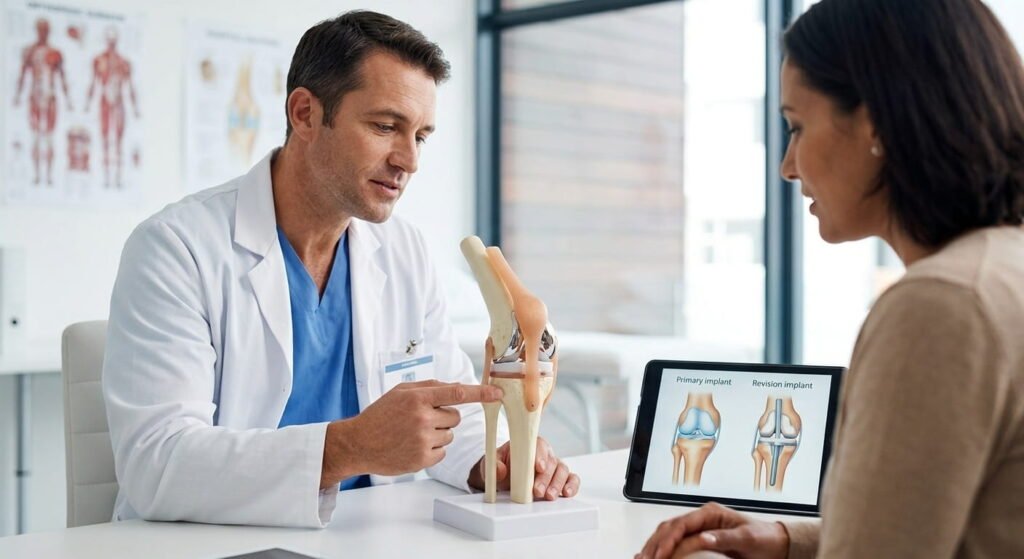

🦵 Revision Knee Replacement: Causes, Symptoms & Solutions
Knee replacement surgery is a highly successful procedure that helps patients regain mobility and live pain-free. However, in some cases, the original implant may fail over time, leading to the need for a Revision Knee Replacement.
This advanced procedure involves replacing or repairing a previously implanted artificial knee joint to restore function and relieve pain.
❓ What is Revision Knee Replacement?
Revision Knee Replacement is a surgical procedure performed when a previous knee replacement fails due to wear, infection, or other complications.
Unlike primary knee replacement, revision surgery is more complex and requires specialized expertise.
⚠️ Causes of Knee Replacement Failure
Several factors can lead to the need for revision knee replacement:
1. Implant Wear & Tear
Over time, the artificial joint may wear out, especially in active patients.
2. Infection
Infection around the implant can damage tissues and loosen the joint.
3. Loosening of Implant
The implant may become loose from the bone, causing instability and pain.
4. Knee Instability
Ligament issues or improper alignment can lead to knee instability.
5. Fracture Around Implant
Bone fractures near the implant may require revision surgery.
🚨 Symptoms You Should Not Ignore
If you have undergone knee replacement and experience the following symptoms, consult a specialist immediately:
- Persistent or increasing knee pain
- Swelling and stiffness
- Difficulty walking or standing
- Instability or feeling of knee “giving way”
- Reduced range of motion
Early diagnosis can prevent further complications.
🏥 Diagnosis & Evaluation
Doctors use a combination of tests to determine the need for revision surgery:
- Physical examination
- X-rays or MRI scans
- Blood tests (to detect infection)
- Joint aspiration
🛠️ Treatment Options & Procedure
🔹 Non-Surgical Treatment (In Early Cases)
- Medications
- Physiotherapy
- Lifestyle modifications
🔹 Revision Knee Replacement Surgery
If non-surgical methods fail, revision surgery is recommended.
During the procedure:
- The old implant is removed
- Damaged bone and tissue are treated
- A new implant is placed
This helps restore knee function and reduce pain.
⏳ Recovery After Revision Surgery
Recovery may take longer than primary knee replacement but offers excellent results when done properly.
🩺 Recovery Tips:
- Follow physiotherapy regularly
- Maintain a healthy weight
- Avoid high-impact activities
- Attend follow-up appointments
Most patients regain mobility and experience significant pain relief.
💡 Why Choose Expert Care?
Revision knee replacement is a complex surgery that requires experienced orthopedic surgeons and advanced facilities.
Choosing the right hospital ensures:
✔ Accurate diagnosis
✔ Safe surgical procedure
✔ Faster recovery
✔ Better long-term outcomes
📞 Book Your Consultation
If you are experiencing symptoms of a failed knee replacement, don’t delay treatment.
👉 Consult an expert orthopedic surgeon today for proper evaluation and treatment.
Call Now: +91 7807940794
Dr. Saravpreet Ahluwalia
MS (Ortho), DNB (Ortho),
MRCS Ed (U.K.), MCh (U.K.), FEBOT (Switzerland),
FRCS Orth (U.K.)
🔥 FAQs (SEO Boost Section)
1. How long does a knee replacement last?
Most knee replacements last 15–20 years, but may fail earlier in some cases.
2. Is revision knee replacement risky?
It is more complex than primary surgery but safe when performed by experienced surgeons.
3. How long is recovery after revision surgery?
Recovery typically takes a few months with proper physiotherapy.
4. What is the cost of revision knee replacement?
The cost varies depending on hospital, surgeon, and condition of the patient.