
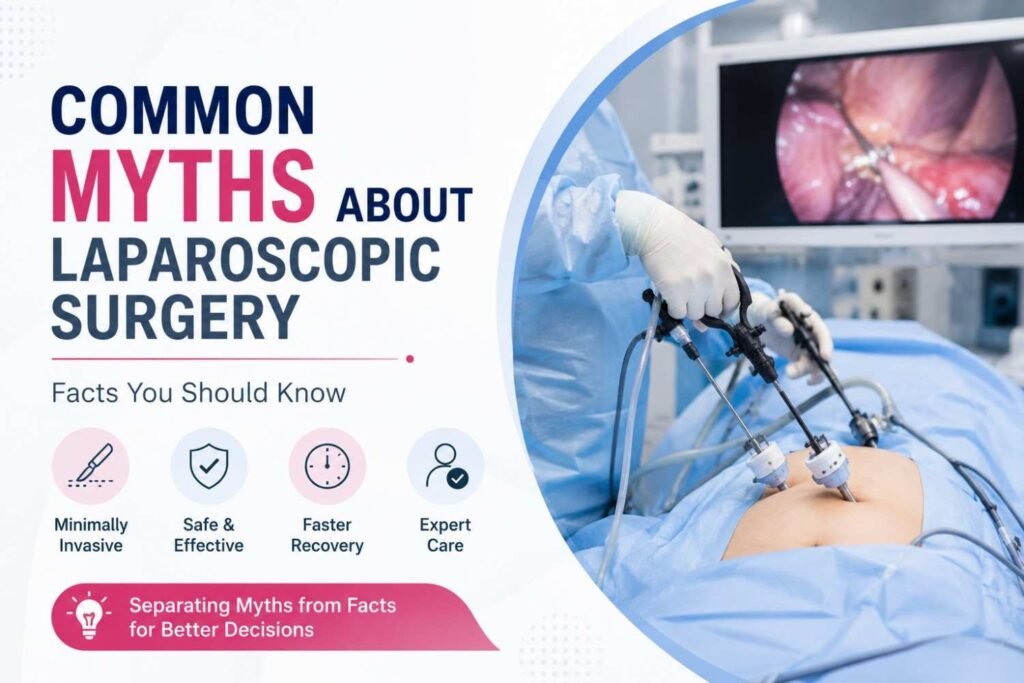

Laparoscopic surgery, often called keyhole surgery or minimally invasive surgery, has changed the way many surgical conditions are treated. Instead of using one large incision, surgeons generally perform laparoscopic procedures through small incisions using a camera and specialized instruments. This approach can offer benefits such as smaller wounds, less postoperative pain and faster recovery for appropriately selected procedures.
However, despite its widespread use, several misconceptions about laparoscopic surgery continue to create anxiety among patients. Some people believe that laparoscopic surgery is always painless, while others worry that it is less effective than traditional open surgery.
The truth is more nuanced: laparoscopic surgery can be an excellent option for many patients, but whether it is appropriate depends on the condition, procedure, patient’s health and surgeon’s assessment.
In this article, we separate common myths from facts to help you make a more informed decision about laparoscopic surgery.
What Is Laparoscopic Surgery?
Laparoscopic surgery is a type of minimally invasive surgery performed through small incisions. A laparoscope—a thin instrument with a camera—is inserted through one of the openings, allowing the surgical team to view the operating area on a monitor. Additional small incisions may be used to introduce specialized surgical instruments.
Depending on the procedure, laparoscopic surgery may be used for conditions involving the abdomen and pelvis. Common examples include:
- Gallbladder removal
- Appendectomy
- Hernia repair
- Certain colorectal procedures
- Some gynecological procedures
- Diagnostic laparoscopy
- Selected bariatric procedures
The exact technique, number of incisions and recovery period vary according to the operation being performed.
Myth 1: Laparoscopic Surgery Is Completely Painless
Fact: Laparoscopic surgery can reduce postoperative discomfort, but it does not mean zero pain.
Because laparoscopic procedures usually involve smaller incisions than conventional open surgery, patients may experience less wound-related discomfort in many circumstances. However, some soreness, abdominal discomfort or bloating can occur after surgery.
Some patients may also experience temporary shoulder discomfort because of the gas used to create space inside the abdomen during certain laparoscopic procedures.
Pain levels can vary depending on:
- Type of surgery
- Duration and complexity of the procedure
- Individual pain tolerance
- Overall health
- Surgical technique
- Postoperative pain management
Therefore, it is more accurate to say laparoscopic surgery may reduce postoperative pain compared with some open procedures, rather than saying it is completely painless.
Myth 2: Laparoscopic Surgery Has No Risks
Fact: Laparoscopic surgery is minimally invasive, but it is still surgery.
Every surgical procedure carries potential risks. Laparoscopic surgery can involve complications such as bleeding, infection, injury to nearby organs or blood vessels, anesthesia-related complications and, in some cases, problems related to the surgical access points.
The risk depends on factors such as:
- The type of procedure
- Patient’s age and health
- Existing medical conditions
- Previous abdominal surgeries
- Complexity of the disease
- Surgical experience
A minimally invasive approach does not mean a procedure is risk-free.
Myth 3: Laparoscopic Surgery Is Always Better Than Open Surgery
Fact: The best surgical approach depends on the individual patient and procedure.
Laparoscopic surgery can offer important advantages for suitable patients, including smaller incisions and potentially shorter hospital stays and faster recovery.
However, open surgery may sometimes be more appropriate.
Factors that can influence the decision include:
- The location and size of the problem
- Severity of the disease
- Previous abdominal operations
- Scar tissue or adhesions
- Patient’s overall medical condition
- Complexity of the surgery
- Surgeon’s assessment
The goal is not to choose the smallest incision at any cost. The goal is to choose the safest and most effective treatment.
Myth 4: Laparoscopic Surgery Is Only Used for Gallbladder Surgery
Fact: Laparoscopy is used for many different surgical procedures.
Gallbladder removal is one of the best-known laparoscopic procedures, but laparoscopic techniques are also used in several other areas of surgery.
Depending on the patient’s condition, laparoscopic approaches may be considered for:
- Hernia surgery
- Appendix removal
- Certain colorectal surgeries
- Bariatric procedures
- Diagnostic procedures
- Selected gynecological surgeries
- Other abdominal procedures
SAGES notes that minimally invasive techniques are used for a range of procedures, including hernia repair, appendectomy, colon resection, gallbladder removal and bariatric surgery.
Myth 5: Recovery Is the Same for Everyone
Fact: Recovery varies from patient to patient.
One of the most common misconceptions about laparoscopic surgery is that every patient will recover within a fixed number of days.
In reality, recovery depends on the type of surgery and the individual patient. A simple diagnostic laparoscopy may have a considerably different recovery timeline from a more complex abdominal operation.
The NHS notes that recovery after laparoscopy varies depending on the procedure; some patients recover relatively quickly, while full recovery after surgical procedures can take several weeks.
Recovery may be influenced by:
- Type of procedure
- Surgical complexity
- Age
- General fitness
- Existing health conditions
- Postoperative complications
- Nature of the patient’s work
Your surgeon should provide personalized instructions regarding exercise, driving, work and other activities.
Myth 6: Laparoscopic Surgery Leaves No Scars
Fact: Laparoscopic surgery generally leaves smaller scars, but scars can still occur.
Laparoscopic surgery uses small incisions, so the resulting scars are usually smaller than those associated with many open procedures.
However, the skin still needs to be opened to introduce the laparoscope and surgical instruments.
Scar appearance depends on factors such as:
- Number and size of incisions
- Surgical technique
- Individual healing
- Infection or wound complications
- Skin type
- Postoperative wound care
So, “smaller scars” is more accurate than “no scars.”
Myth 7: Laparoscopic Surgery Is Not Suitable for Complicated Cases
Fact: Some complex procedures can be performed laparoscopically, but not every patient is a candidate.
Advances in minimally invasive surgery have expanded the range of procedures that can be performed laparoscopically.
However, complexity matters.
For example, extensive scar tissue, severe inflammation, bleeding, altered anatomy or difficulty visualizing important structures may affect whether laparoscopic surgery is appropriate. SAGES patient guidance explains that surgeons may recommend an open approach when visualization is difficult or when patient safety requires it.
This is why a detailed preoperative evaluation is important.
Myth 8: A Laparoscopic Procedure Can Never Become Open Surgery
Fact: In some cases, a surgeon may need to convert to open surgery.
Patients sometimes worry that conversion to open surgery means something has gone wrong.
That is not necessarily the case.
During an operation, the surgeon may determine that continuing laparoscopically is not the safest option. Reasons can include:
- Unexpected bleeding
- Extensive adhesions
- Difficulty identifying anatomy
- Severe inflammation
- Inability to safely access or remove the affected tissue
- Other unexpected findings
SAGES specifically notes that conversion to an open procedure can represent sound surgical judgment when it is considered safer for the patient.
Patient safety always comes first.
Myth 9: Laparoscopic Surgery Is Unsafe Because of the Camera and Instruments
Fact: The laparoscope provides surgeons with a magnified view of the surgical area.
During laparoscopic surgery, the surgeon does not operate “blind.” A camera provides images of the surgical area on a monitor, while specialized instruments are introduced through small access points.
The technology allows surgeons to work within a minimally invasive approach while viewing the operative field.
However, the technology itself does not eliminate surgical risk. Outcomes depend on appropriate patient selection, surgical planning, equipment, anesthesia and the experience of the surgical team.
Myth 10: You Can Return to Normal Activities Immediately
Fact: Minimally invasive surgery may allow faster recovery, but healing still takes time.
Some patients can resume light activities relatively soon after certain laparoscopic procedures. However, this does not mean that the body has completely healed immediately.
Depending on the operation, your surgeon may recommend temporary restrictions on:
- Heavy lifting
- Strenuous exercise
- Driving
- Work
- Sexual activity
- Certain household activities
SAGES patient information commonly encourages early movement after appropriate procedures, while emphasizing that activity should follow the surgeon’s instructions.
Never compare your recovery timeline with another patient’s experience.
What Are the Benefits of Laparoscopic Surgery?
For appropriately selected patients and procedures, laparoscopic surgery may provide several advantages over conventional open surgery.
Potential benefits can include:
1. Smaller Incisions
Laparoscopic procedures generally use several small incisions instead of one larger incision.
2. Less Postoperative Pain in Many Cases
Smaller incisions can reduce wound-related discomfort compared with some open procedures.
3. Faster Recovery
Some laparoscopic procedures allow patients to resume normal activities sooner than comparable open procedures.
4. Shorter Hospital Stay
Depending on the operation, patients may be able to leave the hospital on the same day or after a shorter stay.
5. Smaller Scars
The smaller access points generally result in smaller surgical scars.
6. Earlier Mobility
Early movement is commonly encouraged after appropriate minimally invasive procedures and can be an important part of recovery.
It is important to remember that these benefits vary according to the operation and individual patient.
When Might Open Surgery Be Recommended?
Although laparoscopic surgery is valuable, open surgery remains an important treatment option.
A surgeon may recommend or switch to open surgery when:
- The disease is particularly extensive.
- Severe inflammation makes laparoscopic visualization difficult.
- There is significant bleeding.
- Extensive adhesions are present.
- Important structures cannot be safely identified.
- The patient’s anatomy makes laparoscopic surgery unsuitable.
- The surgeon determines that open surgery provides a safer approach.
The decision should be based on patient safety, surgical effectiveness and individual clinical circumstances, rather than simply choosing one technique over another.
How Can You Prepare for Laparoscopic Surgery?
If your surgeon recommends laparoscopic surgery, preparation may include:
Discuss Your Medical History
Tell your surgical team about existing medical conditions, previous surgeries, allergies and medications.
Follow Preoperative Instructions
You may receive instructions regarding fasting, medications and other preparations before surgery.
Understand the Procedure
Ask what operation is planned, why it is recommended and whether there are alternatives.
Ask About Recovery
Find out approximately how long you may need to rest and when you can return to work, driving and exercise.
Arrange Support at Home
Depending on the procedure and anesthesia, you may need someone to accompany you home and assist you during the initial recovery period.
Questions to Ask Your Surgeon Before Laparoscopic Surgery
Before making a decision, consider asking:
- Why is laparoscopic surgery recommended for me?
- What are the alternatives?
- What are the potential risks?
- What benefits can I realistically expect?
- How long might the surgery take?
- How long will I stay in the hospital?
- When can I return to work?
- When can I exercise or lift heavy objects?
- Could the procedure need to be converted to open surgery?
- What warning signs should I watch for after surgery?
Having an open discussion with your surgeon can help you understand your individual treatment plan.
Key Takeaways
- Laparoscopic surgery is a minimally invasive surgical technique, not a completely risk-free procedure.
- It usually involves smaller incisions than many open procedures.
- It can offer benefits such as reduced wound-related discomfort, smaller scars and faster recovery for suitable procedures.
- Recovery time varies depending on the operation and the patient.
- Laparoscopic surgery is used for many conditions, not only gallbladder problems.
- Open surgery may sometimes be safer or more appropriate.
- Conversion from laparoscopic to open surgery can be a safety decision rather than a surgical failure.
- The best surgical approach should always be determined by a qualified surgeon after evaluating the patient’s condition.
Frequently Asked Questions
Is laparoscopic surgery safe?
Laparoscopic surgery is widely used and can be safely performed in appropriately selected patients. However, like all surgical procedures, it carries potential risks. Your individual risk depends on the procedure, medical history and other factors.
Is laparoscopic surgery painful?
Some discomfort can occur after laparoscopic surgery. Patients may experience abdominal soreness, bloating or temporary shoulder pain. Pain management is part of postoperative care.
Does laparoscopic surgery leave scars?
Yes. Laparoscopic surgery uses small incisions, so scars are generally smaller than those associated with many open procedures, but they do not disappear completely.
How long does it take to recover from laparoscopic surgery?
Recovery varies significantly by procedure. Some patients recover quickly, while more complex operations may require several weeks. Your surgeon can provide a more accurate recovery estimate for your specific procedure.
Can laparoscopic surgery be converted to open surgery?
Yes. If the surgeon determines during the operation that open surgery is safer, conversion may be necessary. This can be a planned safety decision rather than a complication.
Is laparoscopic surgery better than open surgery?
Not necessarily in every situation. Laparoscopic surgery has important advantages for many procedures, but the safest approach depends on the patient’s condition, anatomy, surgical complexity and surgeon’s assessment.
What are some common laparoscopic procedures?
Depending on the clinical situation, laparoscopic surgery may be used for procedures such as gallbladder removal, appendectomy, hernia repair, colorectal surgery and selected bariatric or gynecological procedures.
Conclusion
Many fears surrounding laparoscopic surgery come from myths rather than a clear understanding of how minimally invasive surgery actually works.
Laparoscopic surgery can offer meaningful benefits for appropriately selected patients, including smaller incisions and potentially faster recovery. At the same time, it remains a surgical procedure with potential risks, and it is not automatically the best choice for every patient.
The most important step is to discuss your condition with a qualified surgeon who can evaluate your medical history, explain the available treatment options and recommend the approach that prioritizes safety and effective treatment.
If you are considering laparoscopic surgery, don’t make your decision based on myths or someone else’s experience. Ask questions, understand your options and discuss your individual case with your surgeon.


